Podcast: Play in new window | Download | Embed
Subscribe: Apple Podcasts | Spotify | Pandora | Youtube Music | RSS
In this episode of the Work in Progress podcast, we’re talking about the critical role paid and unpaid home caregiving workers play in our society, and the economic, physical, and emotional toll they face on a daily basis. Importantly, we talk about what can be done to support them as they support us.
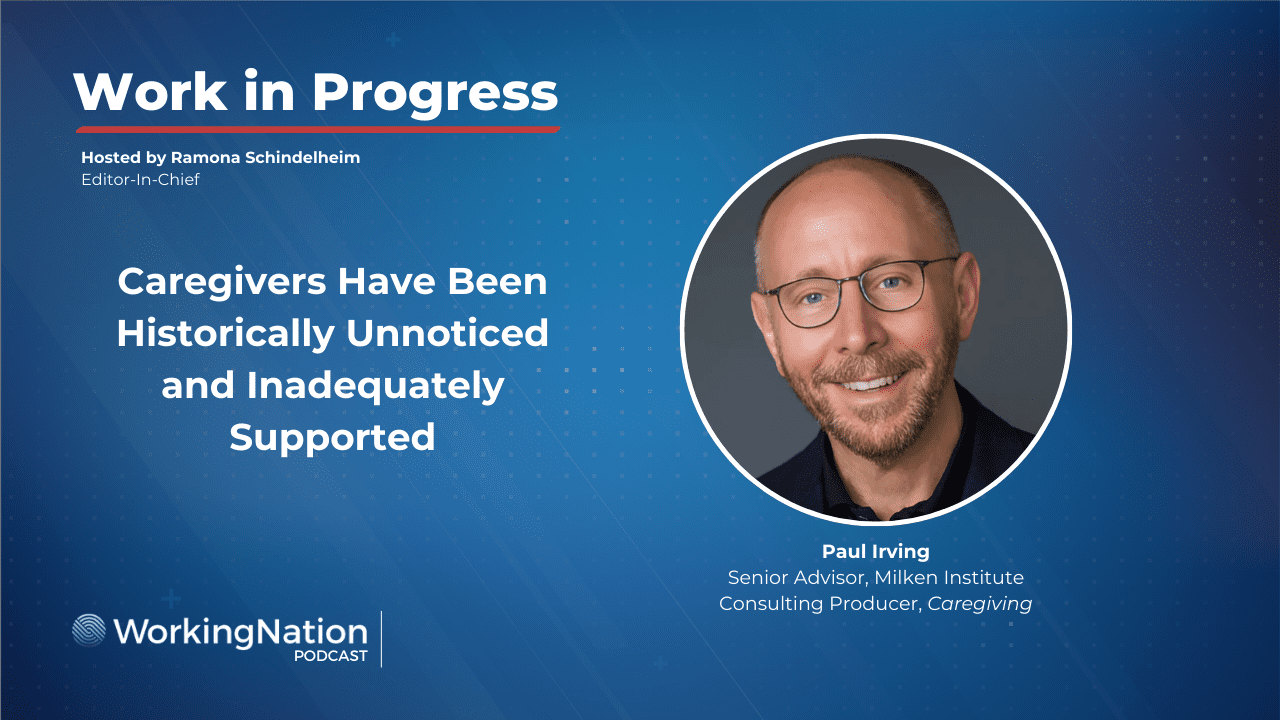
Joining me in the conversation is one of my favorite guests, Paul Irving, a senior advisor to the Milken Institute, a distinguished scholar in residence at the USC Davis School of Gerontology, and the consulting producer for the new documentary Caregiving from executive producer Bradley Cooper.
There are more than five million paid home caregiving workers. Many of these workers are
women and many are immigrants. The days can be long and physical. The pay can be low and the work doesn’t always come with benefits.
Additionally, nearly 106 million U.S. adults provide unpaid caregiving for children and for ill, aging and disabled family members and friends, often at the cost of their own jobs and careers.
As the overall population ages, the American home caregiving system is under more and more stress, tipping toward a crisis. The documentary Caregiving, now streaming on PBS, takes a closer look at the challenges and the triumphs caregivers face every day. It makes the case that they are part of an “invisible army” that is providing a public good and they need our support.
Irving – who also appears in the film – tells me that for people taking care of a loved one and trying to hold down a job, the challenges can be particularly difficult.
“About 60% or so of family caregivers are also working, and their care responsibilities lead to absenteeism and presenteeism, and it affects their productivity,” says Irving.
“It affects their personal health in many, many ways. The stresses and strains of this responsibility that often go on 24 hours a day, seven days a week, have impacts across their lives. And we have nowhere near enough support from employers and from policymakers for the challenges that they face.”
He explains that only about 24% of employers in the private sector offer paid family leave. A relatively small but increasing number also provide other support such as mental health assistance, care navigation assistance, some additional supplemental compensation, and remote or hybrid working arrangements that facilitate care.
Irving points out that direct, paid care workers – oftentimes immigrants, women, and women of color – are equally stressed.
“They are under-compensated, under-recognized, operate in lonely environments without the kinds of services, and supports, and encouragement, and recognition that they so deserve for taking on these incredibly important roles.”
“It’s easy for any of us to brush this off and say this is somehow unimportant until it affects us and our families, and it inevitably does. So, this is an issue that every single one of us, democrats, republicans, independents, those from all regions of the country, every religion, every race, every gender, you name it, we should all be thinking about it, all be striving to try to address and to address quickly.”
In the podcast, Irving and I talk about how he thinks we need to address this growing need for caregivers and how we can better support them economically and emotionally. He has a lot to say on the subject and I believe it’s something everyone should hear.
You can listen to the full conversation here or wherever you get your podcasts. You can also find our podcasts on the Work in Progress YouTube channel.
Actor, director, executive producer Bradley Cooper decided to bring this important issue to light after he became a caregiver to his father.
Irving observes that Cooper is “a highly-educated, smart guy, in addition to being a movie star. And I think he recognized that if the challenges were so significant for him – the frustrations, the loneliness, the learning that needed to be done and all the rest – how must it be for those of us who are not Hollywood movie stars? I think that motivated him to become involved in this work and to become involved in this documentary.”
Caregiving is now streaming on PBS.

Episode 365: Paul Irving, senior advisor, Milken Institute, and consulting producer, Caregiving
Host & Executive Producer: Ramona Schindelheim, Editor-in-Chief, WorkingNation
Producer: Larry Buhl
Theme Music: Composed by Lee Rosevere and licensed under CC by 4
Transcript: Download the transcript for this episode here
Work in Progress Podcast: Catch up on previous episodes here